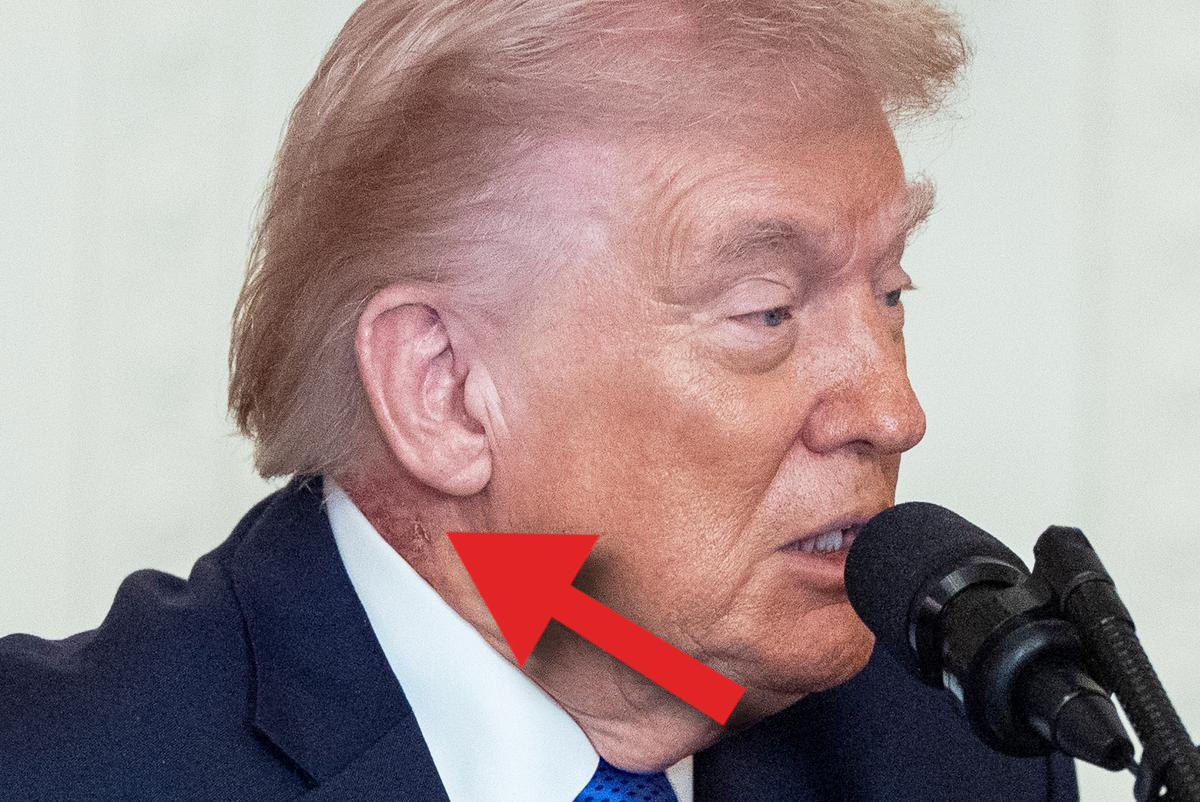
Trump's Health Under the Microscope: New Red Spot Fuels Speculation Amid Age Concerns
The health of any public figure, particularly a prominent presidential candidate, is always under intense scrutiny. But for Donald Trump, who approaches his 80th birthday in June, every visible sign garners heightened attention and often sparks extensive public discussion. The latest instance? A noticeable
red spot on Trump's neck that recently fueled a fresh wave of speculation about his overall well-being. This incident, while seemingly minor, underscores the constant public and media focus on the health of those vying for or holding the highest office.
The Latest Concern: A Red Spot on Trump's Neck
Recent photographs and public appearances have brought a distinctive redness on Donald Trump's right neck to the forefront of health discussions. Described as a red, scaly, and somewhat inflamed-looking patch, the spot was clearly visible, extending above his shirt collar and reaching towards his ear. As expected, this visible anomaly quickly ignited a flurry of rumors and theories across social media and news outlets regarding the former president's health.
In response to the burgeoning concerns, White House physician Dr. Sean Barbabella quickly addressed the speculation. In an official statement disseminated by the White House, Dr. Barbabella explained that "President Trump is using a common cream on the right side of his neck for the prevention of skin irritations. It was prescribed to him by the White House doctor." The statement further clarified that Trump had been applying the cream for approximately a week, and the redness was expected to persist for several more weeks.
However, a crucial detail was conspicuously absent from the official explanation: the underlying cause of the *initial* irritation. While the White House sought to reassure the public by explaining the treatment, the lack of information regarding what prompted the need for the cream left room for continued conjecture. This partial explanation became a focal point for those seeking greater transparency on presidential health.
Age, Health, and the Presidency: A Constant Spotlight
Donald Trump's age is an unavoidable factor in any discussion about his health. Approaching 80, he holds the distinction of being the oldest elected US President in history. This milestone naturally brings presidential health under an even sharper lens, as the demands of the office are immense, both physically and mentally. The public and political opponents alike often question whether an older candidate possesses the stamina and cognitive acuity required for such a rigorous role.
For any public figure, a visible skin anomaly like the "roter fleck Trump Hals" (red spot on Trump's neck), can be amplified through the media cycle. In an election year, such visible signs become particularly potent, feeding narratives about fitness for office. The constant scrutiny means that even seemingly minor health issues can become significant talking points, making transparency and clear communication from official sources paramount.
A History of Scrutiny: Past Health Discussions
This isn't the first time President Trump's physical appearance has sparked health questions, nor is it the first instance where the White House has issued statements to clarify such observations. The intensity of public interest in his well-being has been a recurring theme throughout his political career.
Previous incidents include distinct blue spots often seen on his hand, which drew considerable attention. These were met with differing explanations:
* The White House attributed the bruising to frequent handshaking, a common activity for public figures.
* Trump himself, however, offered a different rationale, publicly stating that he takes high doses of aspirin preventatively due to a fear of heart attacks, which can contribute to easier bruising.
Furthermore, footage from public appearances has occasionally shown Trump with his eyes closed for extended periods, leading some to suggest he was falling asleep. The president vehemently refuted these claims, explaining them as moments of relaxation or simply boredom during lengthy events.
These recurring incidents—from blue spots and closed eyes to the latest
skin irritation on Trump's neck—underscore the intense public interest in a presidential candidate's well-being. They highlight how even minor visible signs can become fodder for extensive debate and speculation, making comprehensive and timely responses from official sources crucial, yet often complex.
Understanding Skin Irritations: General Insights (Not a Diagnosis)
While we cannot offer a diagnosis for President Trump's specific condition, understanding common skin irritations can help contextualize such situations and provide general insights. A "roter fleck Trump Hals" (red spot on Trump's neck) could be caused by various factors that are quite common, especially as people age or live under high stress:
* **Contact Dermatitis:** This occurs when the skin reacts to an irritant (like a new shaving cream, cologne, laundry detergent residue on a collar, or even certain fabrics) or an allergen. Symptoms include redness, itching, scaling, and sometimes blistering.
* **Eczema (Atopic Dermatitis):** Characterized by dry, red, itchy patches of skin. It can be exacerbated by stress, changes in weather, or specific triggers.
* **Actinic Keratosis:** These are rough, scaly patches that develop on sun-exposed skin. They are considered precancerous and often require treatment with creams, cryotherapy, or other dermatological procedures.
* **Psoriasis:** An autoimmune condition causing rapid skin cell turnover, leading to thick, red, scaly patches.
* **Mild Infection:** Bacterial or fungal infections can also cause localized redness and irritation, often accompanied by itching or discomfort.
The use of a "common cream" as described by Dr. Barbabella typically suggests a topical treatment designed to reduce inflammation, hydrate the skin, or treat a specific dermatological condition. These could include mild corticosteroids, emollients, or even anti-fungal preparations, depending on the presumed cause. The expectation that the redness will persist for "several weeks" is also common for various skin conditions, as healing can be a gradual process requiring consistent application of medication and time for the skin to repair itself.
Tips for Maintaining Skin Health:
Regardless of age or profession, proactive skin care is essential. For older individuals, skin often becomes thinner and more delicate, making it more susceptible to irritation and damage.
- Sun Protection: Regular use of broad-spectrum sunscreen, even on areas like the neck, is crucial to prevent sun damage, which can lead to actinic keratosis and other issues.
- Moisturize Regularly: Keep skin hydrated, especially in dry environments or after shaving.
- Identify and Avoid Irritants: Pay attention to how your skin reacts to different products, fabrics, and environmental factors.
- Manage Stress: Stress can exacerbate many skin conditions, including eczema and psoriasis.
- Regular Check-ups: Annual dermatological screenings are advisable, especially for older individuals or those with a history of sun exposure, to catch and treat potential issues early.
The Broader Implications: Transparency vs. Privacy in Public Health
The incident with the red spot on Trump's neck highlights a perennial tension in American politics: the public's perceived right to know about a leader's health versus an individual's right to medical privacy. On one hand, voters reasonably expect a presidential candidate to be physically and mentally fit to undertake one of the world's most demanding jobs. Any visible health concern, no matter how minor, can raise questions about stamina, resilience, and capacity for office.
On the other hand, a candidate, even one under intense public scrutiny, retains a right to a degree of medical privacy. The challenge for the White House and presidential campaigns is to strike a balance: provide enough information to assuage public concern without oversharing personal medical details. Often, as seen with this latest skin irritation, a rapid but incomplete explanation can sometimes fuel *more* speculation rather than quelling it, leading to a cycle of rumors that can be difficult to control in the age of instant information.
In the highly competitive political arena, especially with an upcoming election, health becomes a significant talking point. Every public appearance is scrutinized, and every explanation is weighed against prior statements and public perception. The management of these health narratives is therefore a critical component of any presidential campaign.
The recurring discussions around Donald Trump's health, punctuated by instances like the recent "roter fleck Trump Hals," underscore the intense and often unyielding public scrutiny faced by presidential candidates, particularly those approaching senior years. While the official explanation points to a common skin irritation being treated, the incident served as yet another reminder of the delicate balance between public transparency and personal privacy. As campaigning intensifies, every visible detail will continue to be meticulously observed, analyzed, and discussed, shaping the ongoing narrative about fitness for the nation's highest office.